Crawlability
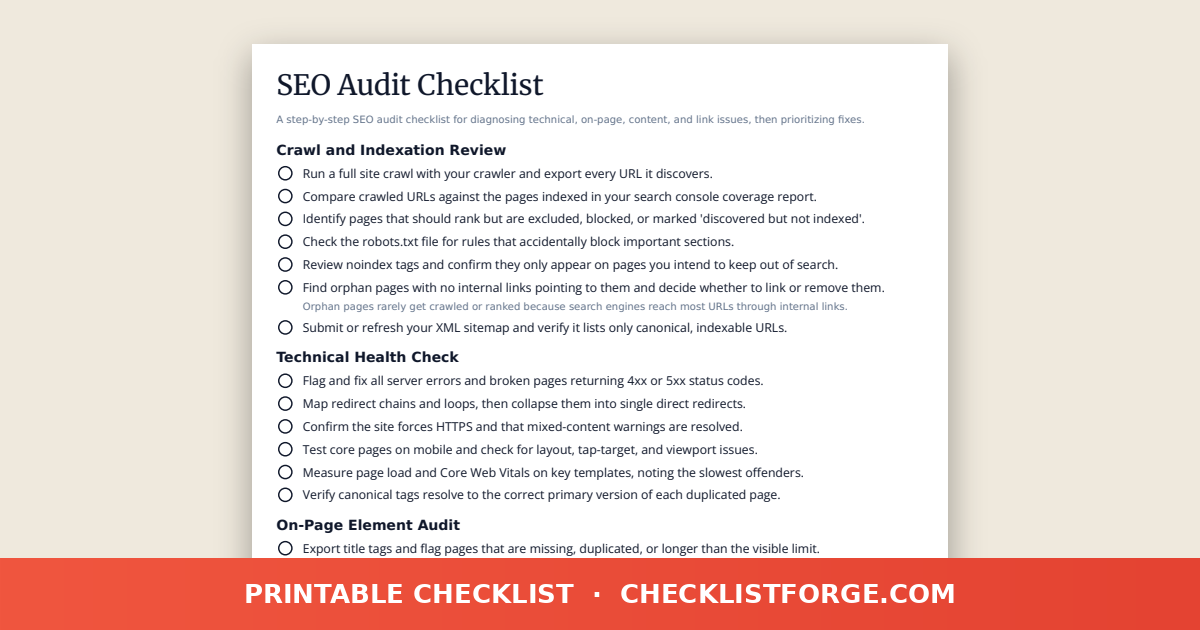
- Open robots.txt and confirm it does not block CSS, JavaScript, or important page directories.
- Run a crawl and resolve every broken internal link and redirect chain it reports.
- Ensure key content is server-rendered or hydrated so crawlers can read it without executing complex scripts.
- Eliminate infinite crawl spaces created by faceted navigation, filters, or calendar parameters.Parameterized URLs can multiply into thousands of near-identical pages and drain crawl budget.
- Build a logical internal linking structure so every important page is reachable within a few clicks.
- Review server logs to confirm crawlers are spending time on valuable pages, not junk URLs.
Indexation
- Audit noindex directives and confirm they appear only on pages you want excluded.
- Use search console coverage reports to find valid pages that are not being indexed.
- Resolve 'crawled but not indexed' and 'discovered but not indexed' statuses on priority pages.
- Remove or consolidate duplicate pages that split indexing signals.
- Request indexing for new or significantly updated high-value pages.
Site Architecture
- Map your URL hierarchy and keep important pages close to the homepage in depth.
- Group related content into clear topic clusters linked to a central hub page.
- Use descriptive, lowercase, hyphenated URLs without session IDs or tracking parameters.
- Add breadcrumb navigation to reinforce hierarchy for users and crawlers.
- Avoid deep folder nesting that buries pages many levels below the root.
Core Web Vitals and Speed
- Measure largest contentful paint and reduce it by optimizing the main hero image or text block.
- Cut layout shift by reserving space for images, ads, and embeds before they load.
- Improve responsiveness by deferring non-critical JavaScript and splitting large bundles.
- Compress and serve images in modern formats with appropriate dimensions.
- Enable browser caching, compression, and a content delivery network for static assets.A CDN shortens the physical distance between your files and the user, which speeds first load.
- Remove render-blocking resources from the critical path of above-the-fold content.
Mobile and HTTPS
- Confirm the site uses responsive design and renders correctly across phone screen sizes.
- Set a proper viewport meta tag and ensure tap targets are large enough to use comfortably.
- Force HTTPS site-wide and redirect all HTTP requests to the secure version.
- Fix mixed-content warnings by serving every asset over HTTPS.
- Verify the SSL certificate is valid, current, and set to auto-renew.
Structured Data
- Add JSON-LD markup that matches the content type of each template, such as articles or products.
- Validate every schema block with a structured data testing tool and fix reported errors.
- Implement breadcrumb, organization, and site-search markup where appropriate.
- Avoid marking up content that is not visible to users on the page.
- Monitor rich result reports for enhancements that lose eligibility after changes.
Sitemaps, Robots, and Canonicals
- Generate an XML sitemap that lists only canonical, indexable, 200-status URLs.
- Reference the sitemap in robots.txt and submit it through search console.
- Split very large sitemaps into multiple files under the per-file URL limit.
- Set a self-referencing canonical tag on every indexable page.
- Point duplicate and parameter URLs to their correct canonical version.Conflicting canonical and noindex signals confuse crawlers, so keep directives consistent on each URL.
- Keep the sitemap automatically updated as pages are published, changed, or removed.
0 / 38 done